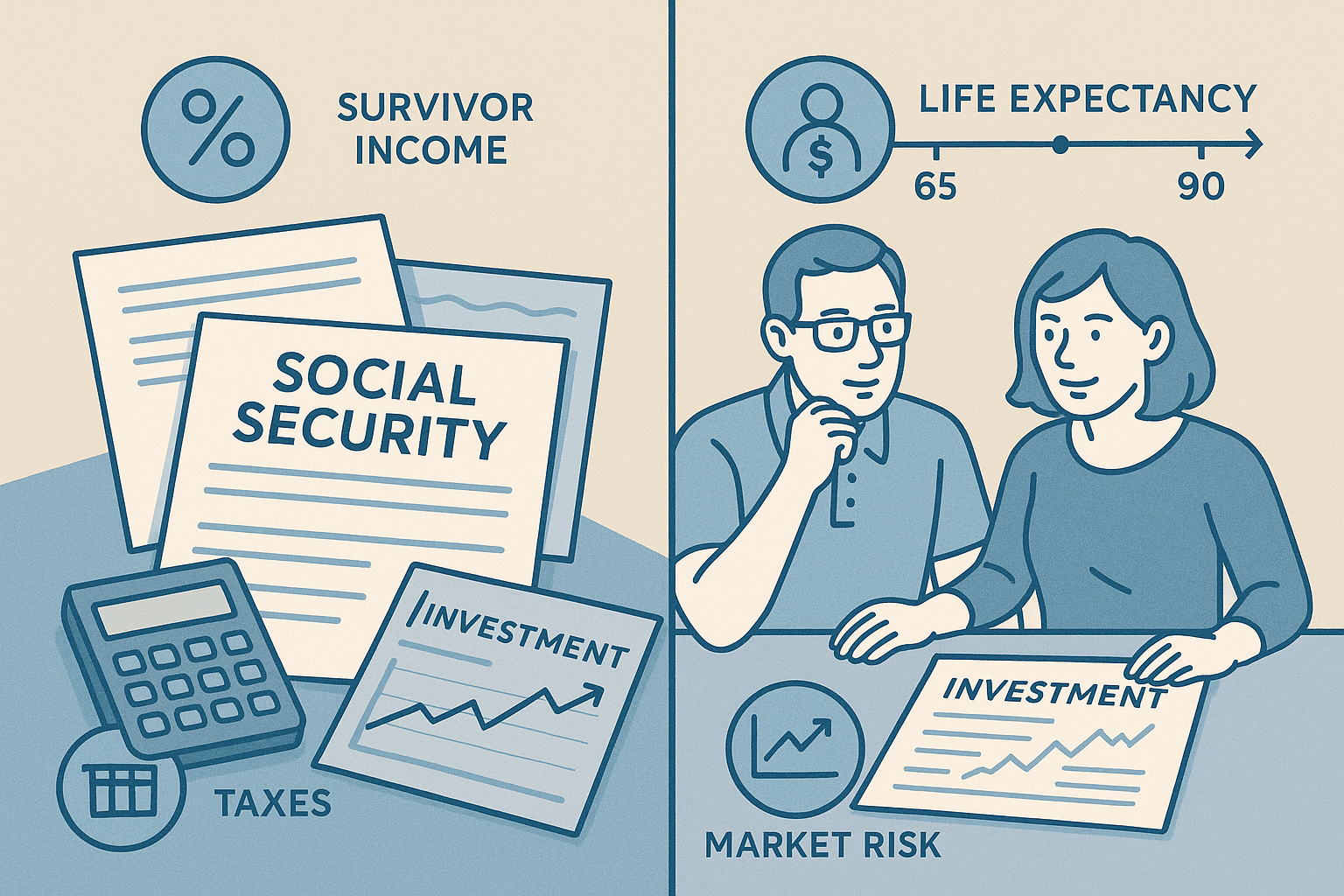
Why a Joint Approach Matters
Retirement choices are interconnected in a household: one spouse’s decision about Social Security, withdrawals, or investment allocations can change the couple’s combined cash flow and tax picture. A joint approach evaluates benefits and income sources together, sets shared priorities (e.g., steady income versus legacy), and creates contingency plans if health or longevity outcomes differ from expectations.
Coordinating Social Security Without One-Size-Fits-All Advice
Deciding when each spouse should claim Social Security affects monthly benefits and the survivor benefit available to the other spouse. Evaluate the trade-offs: claiming earlier increases current cash flow but typically reduces later monthly amounts; delaying increases monthly payments but may not be optimal if life expectancy or other income needs differ. Use benefit estimates to model scenarios for the household, focusing on combined lifetime benefit patterns rather than single-person outcomes.
Planning for Survivor Income and Different Life Expectancies
Because one spouse often lives longer than the other, couples should estimate the household income needed if the higher-earning or higher-benefit spouse predeceases the other. Consider where survivor income would come from — Social Security survivor benefits, pensions, guaranteed sources, or savings — and how to protect a minimum reliable income level. Practical steps include running cash-flow projections and setting aside a guaranteed income buffer to cover essential expenses.
Tax-Efficient Withdrawals for Couples
Withdrawals from taxable, tax-deferred, and tax-free accounts affect household taxes and net income. Coordinate withdrawal sequencing with Social Security claiming and required distributions to manage marginal tax rates and Medicare premiums. Consider a household-level strategy to reduce spikes in taxable income and plan for expected tax events. This section focuses on principles to model, not specific tax moves.
Balancing Income Needs and Market Risk
Couples should decide how much reliable income they require versus how much they can allocate to growth. Techniques such as laddering short-term cash, maintaining a medium-term bond or conservative bucket, and keeping a growth portfolio for long-term needs help balance liquidity and upside. Emphasize conservative withdrawal rates and scenario testing to protect the household against adverse market sequences.
Frequently Asked Questions
When should married couples coordinate Social Security claiming decisions?
Couples should evaluate claiming timing well before either spouse files — ideally during retirement planning discussions — because one spouse’s choice affects household monthly income and survivor benefits. Use benefit estimates to compare scenarios for the household and consider factors such as current income needs, health, and other guaranteed income sources.
How do different life expectancies affect retirement income planning for couples?
Different life expectancies can create survivor income risk if the spouse with the higher benefits or higher savings dies first. Couples should model outcomes under different longevity scenarios, identify essential income needs for a surviving spouse, and consider setting aside reliable income or buffers to protect those needs.
What are practical ways couples can reduce taxes in retirement?
At a household level, practical steps include taking regular tax projections that include Social Security and RMDs, coordinating withdrawals across account types to manage marginal tax brackets, smoothing income where possible, and planning ahead for known tax events. For specific tax moves, consult a tax professional.
How can couples balance the need for steady income with the desire for investment growth?
Couples can separate their assets into roles: short-term cash for immediate needs, a medium-term conservative buffer to cover several years of withdrawals, and a growth portfolio for long-term needs. This layered approach maintains liquidity for near-term expenses while allowing growth to support future spending, and it helps reduce sequence-of-returns risk.
Related Articles in This Series
Want the Full Guide?
Read the full guide for a structured overview of this topic, including key risks, general strategy concepts, and questions to bring into a consultation.